
A favorable PEB combat-related finding may be the most powerful evidence in a Navy or Marine Corps CRSC application. Most applicants have no idea. Here is the standing Navy rule: if the Physical Evaluation Board determined your disability was combat-related, the CRSC Board must adhere to that finding. Only clear and convincing evidence that the PEB erred can displace it. The rule comes from SECNAVCORB Policy Letter 2012-6, and it runs in one direction. Favorable findings bind; unfavorable ones do not. Here is what the policy says, where it came from, and how to use it.
By Kevin Courtney, Esq. | Former USMC Judge Advocate | California Attorney
Two Boards, One Question
Combat-Related Special Compensation, authorized by 10 U.S.C. § 1413a, pays eligible retirees for disabilities that qualify as combat-related. For Sailors and Marines, the CRSC Board sits within the Secretary of the Navy Council of Review Boards. The same organization houses the Physical Evaluation Board.
That structure matters. Both boards answer the same question about the same disability: was it combat-related? The PEB answers it during disability processing. Its rulings document whether an unfitting condition resulted from armed conflict, hazardous service, simulated war, or an instrumentality of war. The CRSC Board answers it later, when the retiree applies for compensation. For years, each board answered independently — and they sometimes disagreed. A Marine could leave the PEB with a combat-related finding in hand and apply for CRSC. Then a sister board in the same building could reach the opposite conclusion.
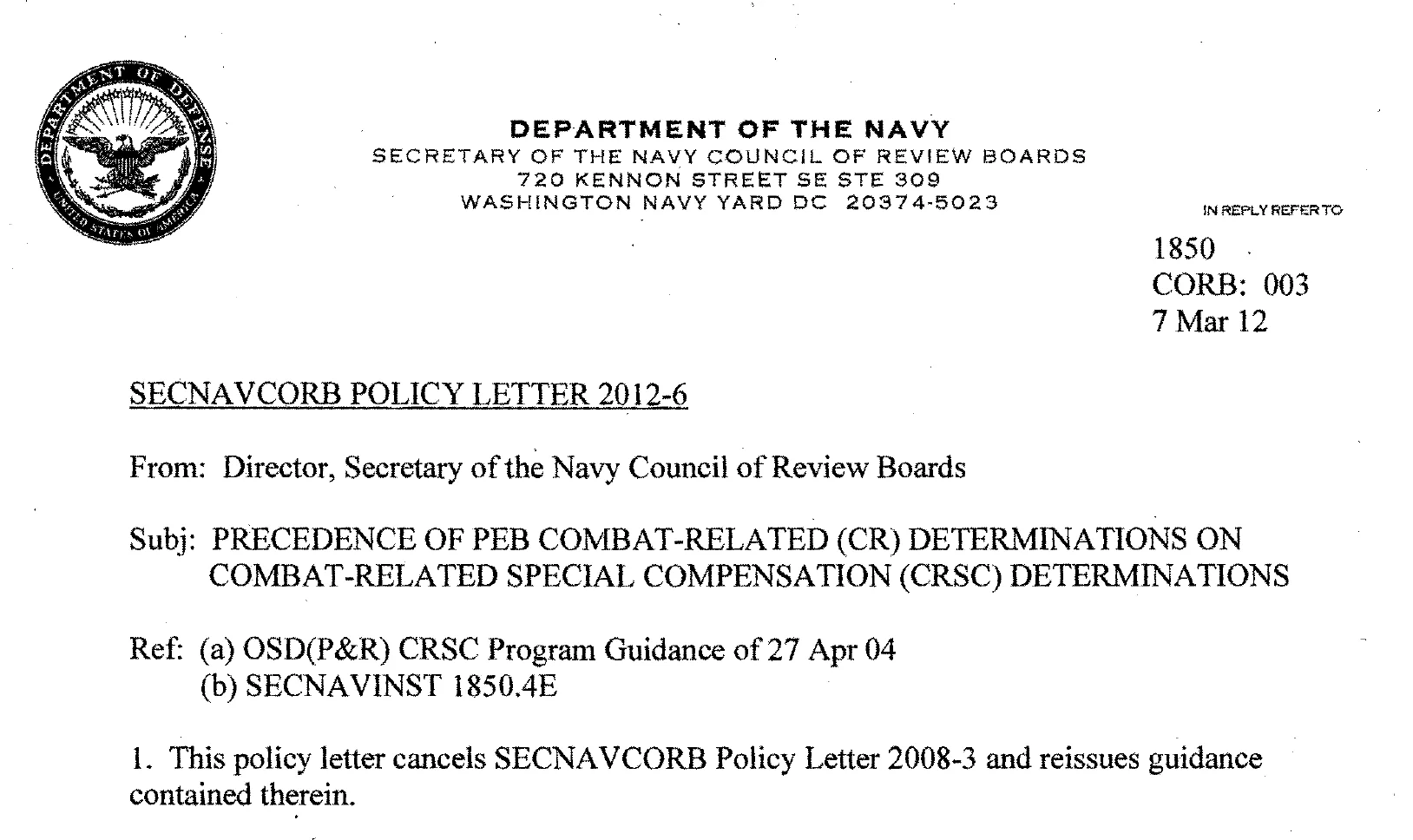
The Council of Review Boards recognized the problem. Conflicting findings from two CORB boards, the Director wrote, “can be viewed as inequitable and indicative of a lack of uniform standards.” The fix is Policy Letter 2012-6.
What Policy Letter 2012-6 Actually Says
The Director of the Council of Review Boards issued SECNAVCORB Policy Letter 2012-6 on March 7, 2012. It sets the rule in two sentences. First: “in the absence of clear and convincing evidence the PEB’s determination was in error, the CRSC Board will adhere to previous PEB determinations a disability is [combat-related] in the adjudication of CRSC applications.” Second: “The CRSC Board, however, is not bound by a previous PEB determination a condition was not [combat-related], and will make their determination based upon the current evidence of record.”
Two details deserve attention. The letter canceled and reissued Policy Letter 2008-3. In other words, this has been CORB policy since at least 2008 — not a recent experiment. And the standard protecting a favorable finding is “clear and convincing evidence” of error, which is a demanding standard. The government cannot brush aside a PEB combat-related finding just because a later reviewer weighs the file differently. It needs evidence that makes the error highly probable.
The One-Way Ratchet in Your Favor
Read the two sentences together and you see something unusual: an asymmetry that always helps the applicant. A PEB finding that your disability is combat-related locks in, absent clear and convincing error. A PEB finding that it is not combat-related locks in nothing. The CRSC Board takes a fresh look at the current record.
In practice, that means the policy helps you twice. If the PEB said yes, you hold a nearly conclusive card, and your application should lead with it. If the PEB said no, you are not stuck with that answer. You can build a better record — additional medical evidence, unit records, decoration citations. Then you ask the CRSC Board to decide on evidence the PEB never saw.
Where PEB Combat-Related Findings Come From
The PEB makes combat-related determinations for the unfitting conditions it adjudicates during disability processing. Those findings appear in the PEB’s written rulings. They carry consequences beyond CRSC, too — for example, the tax treatment of disability severance. If you went through a medical board, your findings are in your disability processing records.
The scope limit matters. The PEB only rules on conditions before it. Maybe the PEB never adjudicated your condition — it was not unfitting, or you never went through disability processing. That condition carries no PEB combat-related finding to bind anyone. For those conditions, the CRSC Board decides independently, and your evidence must do the work on its own. Our post on the four types of Navy and Marine Corps CRSC explains what to prove for each qualifying category.
How to Use a PEB Combat-Related Finding
If you are applying for CRSC, do not assume the board will dig your PEB findings out of the file. Lead with them. Attach the PEB rulings that document the combat-related determination. Identify each condition covered, and cite Policy Letter 2012-6 by name. Make it easy for the board to follow its own policy.
If you were already denied, compare the denial letter to your PEB findings, condition by condition. Did the board deny a condition despite a favorable PEB combat-related finding, without clear and convincing evidence of error? That denial sits directly at odds with CORB’s written policy. It is a strong basis for reconsideration, and the reconsideration request should quote the letter and attach the PEB ruling. If reconsideration fails, the next stop is the Board for Correction of Naval Records. There, the same argument becomes a claim of error in your record. Our step-by-step guide on how to appeal a CRSC denial walks through both paths.
Preparing a first application? Pair this argument with the fundamentals: qualifying categories, causation evidence, and clean documentation. Our post on the six errors to avoid in your CRSC application covers them.
Limits and Cautions
Honest scope notes, because this rule is powerful but not magic. It is Navy and Marine Corps policy. CORB governs the Navy’s PEB and CRSC Board, not the Army’s or Air Force’s. Other branches make independent determinations, though the fairness logic can still persuade. PEB silence is not a PEB “no” — a condition the PEB never addressed simply falls outside the letter. The binding effect goes to the combat-related question only. It does not set your VA rating, calculate your payment, or guarantee any amount. Finally, a VA service-connection finding is not a combat-related finding. The standards differ, and conflating them is one of the most common application mistakes we see.
When to Talk With a CRSC Attorney
If your denial contradicts your own PEB findings, you hold one of the cleanest appeal arguments in this practice area. But the argument still has to be built. That means matching conditions across two record sets, quoting the right authority, and holding the board to its own standard. That is the review a CRSC attorney should walk through with you before you refile. The stakes are monthly, tax-free compensation — so do not sit on a denial.
Above all else, Kevin Courtney takes his work seriously. He does not take cases or his client’s issues lightly and applies only his most diligent efforts to every case that he represents. This, coupled with his knowledge and legal expertise, makes him one of the most exceptional attorneys in his field. — Matthew Grange, Attorney Review on Justia.com.
Every case is different, and past results do not guarantee future outcomes.
This article is general information and is not legal advice. Every case is different, and outcomes depend on the record, the requested relief, the applicable board, and the strength of the evidence. Past results do not guarantee future outcomes. If you have questions about your situation, speak with a qualified military law attorney.
The Bottom Line
For Sailors and Marines, a favorable PEB combat-related finding is close to decisive in a CRSC application. Policy Letter 2012-6 says the CRSC Board “will adhere” to it absent clear and convincing evidence of error. An unfavorable finding, by contrast, binds nothing. Did the CRSC Board deny a condition your PEB already found combat-related? Request a CRSC review and let’s look at your PEB findings together.
PEB Combat-Related Findings: FAQs
Does this rule apply to Army or Air Force CRSC decisions?
No. Policy Letter 2012-6 is Navy Department policy, binding within the Council of Review Boards — which serves Sailors and Marines. The Army and Air Force CRSC agencies make independent determinations. A favorable PEB finding is still strong evidence in any branch. Only the Navy, however, has made it binding by written policy.
The PEB never reviewed my condition. Does the letter help me?
Not directly. The letter binds the CRSC Board only to determinations the PEB actually made. Conditions the PEB never adjudicated get an independent CRSC review. Your application must prove the combat-related connection with its own evidence: medical records, unit documents, decorations, and witness statements.
The PEB found my condition was NOT combat-related. Am I stuck?
No — this is the other half of the one-way rule. The CRSC Board is not bound by an unfavorable PEB determination and must decide on the current evidence of record. If you can present evidence the PEB never saw, the CRSC Board owes you a fresh look.
My CRSC denial contradicts my PEB finding. What now?
Request reconsideration, and make the conflict impossible to miss. Quote Policy Letter 2012-6, attach the PEB ruling, and note the decision offers no clear and convincing evidence of PEB error. If reconsideration fails, the Board for Correction of Naval Records can correct the record. Deadlines and framing matter at each step, so get an assessment early.
Does a binding combat-related finding guarantee payment?
No. The finding resolves the combat-related question for that condition — a major hurdle, but one of several. Eligibility, VA ratings, and the payment calculation still apply. No one can promise an amount without your full record.