Blog

By Kevin Courtney, Esq.  |  Former USMC Judge Advocate  |  California Attorney

If your less-than-honorable discharge traces back to drinking, you are not looking at a lost cause. An alcohol-related discharge upgrade is often possible. The key is showing that the drinking was a symptom of a condition the military never treated. That is very different from bad character. The science here is on your side, and so is current Department of Defense policy. Below, I explain how childhood trauma and combat deployment raise the odds of alcohol problems. I show how that connects to the legal standard boards apply. And I explain what a strong petition actually requires, and where these cases get hard.

A discharge characterized as anything below honorable follows you. It can block VA benefits, complicate employment, and quietly shape how people read your service. Often the conduct was alcohol-related: missed formations, an off-base incident, a failed rehabilitation program. Many veterans assume the record is permanent and that they earned it. That assumption is usually wrong.

Here is the reframe that matters. Boards no longer treat every drinking-related separation as a pure character failure. Instead, they are now required to ask whether a mental health condition contributed to the behavior. That shift is what makes an alcohol-related discharge upgrade realistic for the right applicant. The science explains why so many of these cases fit that pattern.

The science, part one: childhood trauma sets the stage

The link between a hard childhood and later drinking is one of the most studied findings in public health. The CDC–Kaiser Adverse Childhood Experiences (ACE) study found a strong, stepwise relationship. As a person’s count of adverse childhood experiences rises, so does the risk of alcohol problems in adulthood. This is not a small effect. People with several ACEs carry a substantially higher risk of alcohol use disorder than people with none.

Now layer in who serves. Research comparing veterans with civilians points the same way. Those who enlisted report childhood adversity at notably higher rates. For many, the military was a way out of a troubled home. So a large share of recruits arrived already carrying the risk factors that predict alcohol problems under stress. The military did not create that vulnerability. But it was already in the ranks, and the statistics made it predictable.

The science, part two: the brain isn’t finished at enlistment

The brain’s prefrontal cortex — the part that governs judgment, planning, and impulse control — keeps maturing into the mid-twenties. That means most recruits are still developing when they put on the uniform. The same is true for many who deploy.

This matters for two reasons. First, a still-developing brain is more vulnerable to alcohol’s effects. That is part of why substance use disorders show up most often among service members under twenty-five. Second, combat changes the equation. Research on the young-adult brain and on military cohorts points the same direction. High combat exposure raises the rate of problem drinking. So the services sent young troops into danger before their brains finished maturing. That raised the odds they would cope with alcohol, and later struggle with it.

None of this excuses harmful conduct. But it reframes the drinking as a predictable disorder with roots. It is not a free choice made by someone of bad character. That distinction is exactly what a board is supposed to weigh.

Since 2014, the Department of Defense has directed the boards to apply “liberal consideration.” It covers discharge upgrade petitions involving mental health conditions. Three memoranda govern: Hagel (2014), Kurta (2017), and Wilkie (2018). They tell boards to weigh whether a condition contributed to the misconduct. That holds even when the misconduct itself is not in dispute.

For a fuller walk-through of this standard, watch my video on the liberal consideration standard for discharge upgrades. There are two ways to put alcohol inside that framework.

Ground one: alcohol use disorder as a mental health condition

Alcohol use disorder is a diagnosable mental health condition. The Kurta memo extends liberal consideration to “other mental health conditions.” It leaves that category open rather than limiting it to PTSD. So a diagnosed alcohol use disorder can be argued as a qualifying condition in its own right. Be clear-eyed, though. When the misconduct is the drinking, a board may see the argument as circular. The condition and the offense collapse into each other. It is a legitimate argument, but on its own it is the weaker one.

Ground two: drinking as self-medication of an underlying condition

This is the stronger path. The Kurta memo speaks to it directly. It tells boards that substance-seeking behavior and efforts to self-medicate a mental health condition warrant consideration. Maybe the drinking was how you managed undiagnosed PTSD, military sexual trauma, depression, or anxiety. If so, the alcohol is evidence of an underlying condition, not the whole story. Here the ACE and brain-development science does real work. It supplies the reason the disorder developed and ties it to a documented history. That strengthens the link a board needs to see.

The honest caveat: liberal consideration does not mandate an upgrade. A board still decides whether the condition both mitigates and outweighs the misconduct. And no published rule squarely holds that alcohol use disorder alone qualifies. The best petitions argue both grounds, lead with the self-medication theory, and prove the connection.

Which board hears your discharge upgrade petition

Two forums handle these cases, and the timeline decides which one applies. The Discharge Review Board (DRB) reviews petitions filed within fifteen years of separation, using DD Form 293. After that window closes, the petition goes to your branch’s Board for Correction of Military Records (BCMR). For the Navy and Marine Corps, that is the Board for Correction of Naval Records (BCNR). Both use DD Form 149, and they also handle relief the DRB cannot grant. The DRB cannot touch a discharge issued by a general court-martial. If you are unsure which board applies, that is a question worth resolving early, because it shapes the entire filing.

A diagnosis by itself rarely carries a petition. Boards look for a clear, documented nexus — a connection that explains why the misconduct happened. A strong alcohol-related discharge upgrade usually brings together several things:

  • A current diagnosis of alcohol use disorder, plus any underlying condition such as PTSD, MST-related trauma, depression, or anxiety.
  • Evidence of the nexus — records or a clinician’s opinion linking the condition to the conduct that led to separation.
  • History that explains origin — childhood adversity, your age and deployment, and combat exposure, offered as context, not excuse.
  • Rehabilitation and sobriety — treatment records, recovery milestones, and post-service conduct that speak to who you are now.
  • A coherent narrative that moves from cause to conduct to recovery, told in your own words.

For more on assembling proof, see our guide to the strongest evidence for a discharge upgrade.

Common mistakes that weaken these petitions

Most denials I see are avoidable. The first mistake is leaning on the science alone. A moving backstory with no diagnosis and no nexus gives the board nothing to work with. The second is treating the history as an excuse rather than an explanation. Boards respond to accountability paired with context, not to blame-shifting. The third is missing the fifteen-year DRB window without realizing the BCMR or BCNR may still hear the case. And the fourth is submitting a thin file and hoping sympathy fills the gaps. It does not. For how this standard plays out in practice, read what liberal consideration really means for a mental-health discharge upgrade.

When to talk with a military law attorney

You can file on your own, and some veterans do it well. But these petitions turn on medical-legal nexus, careful framing, and a record built to anticipate how a board reads it. Maybe your separation involved alcohol and you believe an untreated condition drove it. A focused case review can tell you whether the facts support a petition, and which forum fits. If your situation also involves drugs, our explainer on upgrading a discharge tied to substance use covers closely related ground.

Request a case review to discuss whether your record supports an upgrade.

This article is general information and is not legal advice. Every case is different, and outcomes depend on the record, the requested relief, the applicable board, and the strength of the evidence. Past results do not guarantee future outcomes. If you have questions about your situation, speak with a qualified military law attorney.

The bottom line

The drinking that ended a service member’s career rarely came from nowhere. For many veterans, it grew out of childhood adversity and combat exposure that landed on a brain still under construction. Current policy gives the boards room to see that. A well-built alcohol-related discharge upgrade petition gives them three things: the diagnosis, the nexus, and the record. Those are what a board needs to act.

Military Law helped me with a petition to have my discharge upgraded. I brought Kevin my case, he looked at it and said “I can help you.” he did that tremendously. Kevin stayed in contact with me throughout the process and when he wasnt able to, his office staff were always a pleasure to work with. We had 1 shot and Kevin executed the task perfectly. I would recommend anyone in need of military related legal services to contact Kevin Courtney at Military Law without hesitation.

— Verified client review, Avvo, September 24, 2025. Every case is different, and past results do not guarantee future outcomes.

If that sounds like your story, the next step is a candid review of the facts. To explore whether the firm can help, work with a military discharge upgrade attorney who handles these petitions. You can also read more client reviews.

Frequently asked questions

Can I get an alcohol-related discharge upgrade if I was never diagnosed during service?

Often, yes. Boards may consider conditions that were undiagnosed or misdiagnosed at the time. Current policy allows liberal consideration even when the diagnosis came later. A current evaluation that links the condition to your service usually carries more weight than a contemporaneous note alone.

Does alcohol use disorder qualify for a discharge upgrade on its own?

It can be argued as a qualifying mental health condition, because the governing memo reaches “other mental health conditions.” On its own, though, it is the weaker argument. The disorder and the misconduct can look like the same thing. The stronger approach pairs it with evidence that the drinking was self-medication of an underlying condition.

How does childhood trauma help my discharge upgrade case?

It supplies origin and credibility. Documented adverse childhood experiences help explain why an alcohol use disorder developed. They connect it to a trauma history, which strengthens the nexus a board must weigh. It is context that supports the legal argument, not a stand-alone basis for relief.

Is there a deadline to file a discharge upgrade?

The Discharge Review Board reviews petitions within fifteen years of separation. After that, the Board for Correction of Military Records may still hear the case. For the Navy and Marine Corps, that is the Board for Correction of Naval Records. Filing sooner is generally better, but a closed DRB window does not necessarily end your options.

Will the board hold my drinking against me?

Liberal consideration directs boards to weigh whether a condition contributed to the misconduct. It does not treat the drinking as automatic proof of bad character. A board still decides whether the mitigation outweighs the conduct. So the quality of your evidence and your post-service record matters a great deal.

Do I need a lawyer for an alcohol-related discharge upgrade?

No, but representation helps where it counts. That means building the nexus, framing the narrative, choosing the right forum, and anticipating an advisory opinion. A case review can tell you whether your facts support a petition before you invest in the filing.

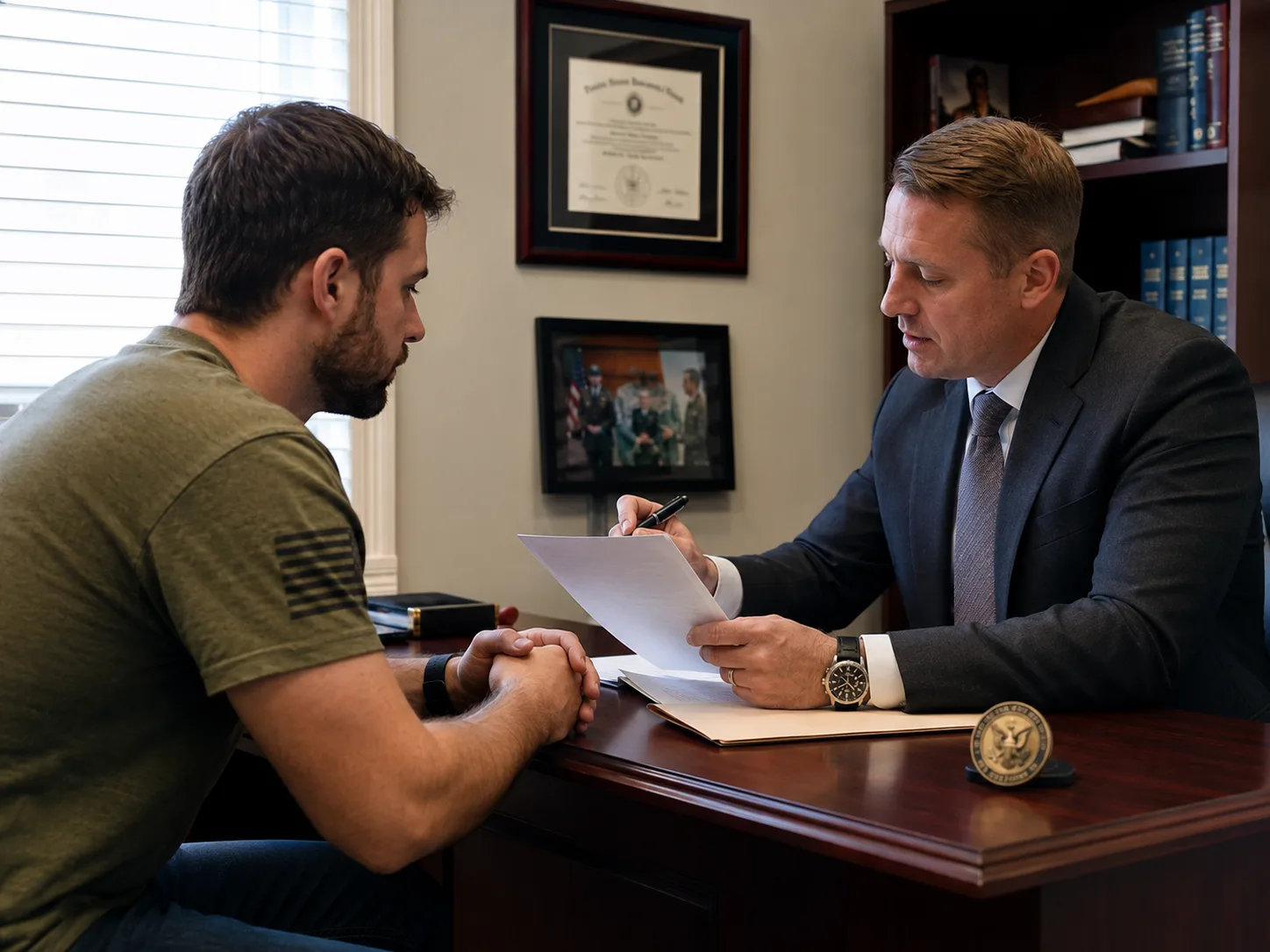
Veteran preparing an alcohol-related discharge upgrade petition with a military law attorney An alcohol-related discharge upgrade turns on the link between the drinking and an underlying condition.
Alcohol-Related Discharge Upgrade: The Childhood Trauma and Combat Connection

By Kevin Courtney, Esq.  |  Former USMC Judge Advocate  |  California Attorney

If your less-than-honorable discharge traces back to drinking, you are not looking at a lost cause. An alcohol-related discharge upgrade is often possible. The key is showing that the drinking was a symptom of a condition the military never treated. That is very different from bad character. The science here is on your side, and so is current Department of Defense policy. Below, I explain how childhood trauma and combat deployment raise the odds of alcohol problems. I show how that connects to the legal standard boards apply. And I explain what a strong petition actually requires, and where these cases get hard.

A discharge characterized as anything below honorable follows you. It can block VA benefits, complicate employment, and quietly shape how people read your service. Often the conduct was alcohol-related: missed formations, an off-base incident, a failed rehabilitation program. Many veterans assume the record is permanent and that they earned it. That assumption is usually wrong.

Here is the reframe that matters. Boards no longer treat every drinking-related separation as a pure character failure. Instead, they are now required to ask whether a mental health condition contributed to the behavior. That shift is what makes an alcohol-related discharge upgrade realistic for the right applicant. The science explains why so many of these cases fit that pattern.

The science, part one: childhood trauma sets the stage

The link between a hard childhood and later drinking is one of the most studied findings in public health. The CDC–Kaiser Adverse Childhood Experiences (ACE) study found a strong, stepwise relationship. As a person’s count of adverse childhood experiences rises, so does the risk of alcohol problems in adulthood. This is not a small effect. People with several ACEs carry a substantially higher risk of alcohol use disorder than people with none.

Now layer in who serves. Research comparing veterans with civilians points the same way. Those who enlisted report childhood adversity at notably higher rates. For many, the military was a way out of a troubled home. So a large share of recruits arrived already carrying the risk factors that predict alcohol problems under stress. The military did not create that vulnerability. But it was already in the ranks, and the statistics made it predictable.

The science, part two: the brain isn’t finished at enlistment

The brain’s prefrontal cortex — the part that governs judgment, planning, and impulse control — keeps maturing into the mid-twenties. That means most recruits are still developing when they put on the uniform. The same is true for many who deploy.

This matters for two reasons. First, a still-developing brain is more vulnerable to alcohol’s effects. That is part of why substance use disorders show up most often among service members under twenty-five. Second, combat changes the equation. Research on the young-adult brain and on military cohorts points the same direction. High combat exposure raises the rate of problem drinking. So the services sent young troops into danger before their brains finished maturing. That raised the odds they would cope with alcohol, and later struggle with it.

None of this excuses harmful conduct. But it reframes the drinking as a predictable disorder with roots. It is not a free choice made by someone of bad character. That distinction is exactly what a board is supposed to weigh.

Since 2014, the Department of Defense has directed the boards to apply “liberal consideration.” It covers discharge upgrade petitions involving mental health conditions. Three memoranda govern: Hagel (2014), Kurta (2017), and Wilkie (2018). They tell boards to weigh whether a condition contributed to the misconduct. That holds even when the misconduct itself is not in dispute.

For a fuller walk-through of this standard, watch my video on the liberal consideration standard for discharge upgrades. There are two ways to put alcohol inside that framework.

Ground one: alcohol use disorder as a mental health condition

Alcohol use disorder is a diagnosable mental health condition. The Kurta memo extends liberal consideration to “other mental health conditions.” It leaves that category open rather than limiting it to PTSD. So a diagnosed alcohol use disorder can be argued as a qualifying condition in its own right. Be clear-eyed, though. When the misconduct is the drinking, a board may see the argument as circular. The condition and the offense collapse into each other. It is a legitimate argument, but on its own it is the weaker one.

Ground two: drinking as self-medication of an underlying condition

This is the stronger path. The Kurta memo speaks to it directly. It tells boards that substance-seeking behavior and efforts to self-medicate a mental health condition warrant consideration. Maybe the drinking was how you managed undiagnosed PTSD, military sexual trauma, depression, or anxiety. If so, the alcohol is evidence of an underlying condition, not the whole story. Here the ACE and brain-development science does real work. It supplies the reason the disorder developed and ties it to a documented history. That strengthens the link a board needs to see.

The honest caveat: liberal consideration does not mandate an upgrade. A board still decides whether the condition both mitigates and outweighs the misconduct. And no published rule squarely holds that alcohol use disorder alone qualifies. The best petitions argue both grounds, lead with the self-medication theory, and prove the connection.

Which board hears your discharge upgrade petition

Two forums handle these cases, and the timeline decides which one applies. The Discharge Review Board (DRB) reviews petitions filed within fifteen years of separation, using DD Form 293. After that window closes, the petition goes to your branch’s Board for Correction of Military Records (BCMR). For the Navy and Marine Corps, that is the Board for Correction of Naval Records (BCNR). Both use DD Form 149, and they also handle relief the DRB cannot grant. The DRB cannot touch a discharge issued by a general court-martial. If you are unsure which board applies, that is a question worth resolving early, because it shapes the entire filing.

A diagnosis by itself rarely carries a petition. Boards look for a clear, documented nexus — a connection that explains why the misconduct happened. A strong alcohol-related discharge upgrade usually brings together several things:

  • A current diagnosis of alcohol use disorder, plus any underlying condition such as PTSD, MST-related trauma, depression, or anxiety.
  • Evidence of the nexus — records or a clinician’s opinion linking the condition to the conduct that led to separation.
  • History that explains origin — childhood adversity, your age and deployment, and combat exposure, offered as context, not excuse.
  • Rehabilitation and sobriety — treatment records, recovery milestones, and post-service conduct that speak to who you are now.
  • A coherent narrative that moves from cause to conduct to recovery, told in your own words.

For more on assembling proof, see our guide to the strongest evidence for a discharge upgrade.

Common mistakes that weaken these petitions

Most denials I see are avoidable. The first mistake is leaning on the science alone. A moving backstory with no diagnosis and no nexus gives the board nothing to work with. The second is treating the history as an excuse rather than an explanation. Boards respond to accountability paired with context, not to blame-shifting. The third is missing the fifteen-year DRB window without realizing the BCMR or BCNR may still hear the case. And the fourth is submitting a thin file and hoping sympathy fills the gaps. It does not. For how this standard plays out in practice, read what liberal consideration really means for a mental-health discharge upgrade.

When to talk with a military law attorney

You can file on your own, and some veterans do it well. But these petitions turn on medical-legal nexus, careful framing, and a record built to anticipate how a board reads it. Maybe your separation involved alcohol and you believe an untreated condition drove it. A focused case review can tell you whether the facts support a petition, and which forum fits. If your situation also involves drugs, our explainer on upgrading a discharge tied to substance use covers closely related ground.

Request a case review to discuss whether your record supports an upgrade.

This article is general information and is not legal advice. Every case is different, and outcomes depend on the record, the requested relief, the applicable board, and the strength of the evidence. Past results do not guarantee future outcomes. If you have questions about your situation, speak with a qualified military law attorney.

The bottom line

The drinking that ended a service member’s career rarely came from nowhere. For many veterans, it grew out of childhood adversity and combat exposure that landed on a brain still under construction. Current policy gives the boards room to see that. A well-built alcohol-related discharge upgrade petition gives them three things: the diagnosis, the nexus, and the record. Those are what a board needs to act.

Military Law helped me with a petition to have my discharge upgraded. I brought Kevin my case, he looked at it and said “I can help you.” he did that tremendously. Kevin stayed in contact with me throughout the process and when he wasnt able to, his office staff were always a pleasure to work with. We had 1 shot and Kevin executed the task perfectly. I would recommend anyone in need of military related legal services to contact Kevin Courtney at Military Law without hesitation.

— Verified client review, Avvo, September 24, 2025. Every case is different, and past results do not guarantee future outcomes.

If that sounds like your story, the next step is a candid review of the facts. To explore whether the firm can help, work with a military discharge upgrade attorney who handles these petitions. You can also read more client reviews.

Frequently asked questions

Can I get an alcohol-related discharge upgrade if I was never diagnosed during service?

Often, yes. Boards may consider conditions that were undiagnosed or misdiagnosed at the time. Current policy allows liberal consideration even when the diagnosis came later. A current evaluation that links the condition to your service usually carries more weight than a contemporaneous note alone.

Does alcohol use disorder qualify for a discharge upgrade on its own?

It can be argued as a qualifying mental health condition, because the governing memo reaches “other mental health conditions.” On its own, though, it is the weaker argument. The disorder and the misconduct can look like the same thing. The stronger approach pairs it with evidence that the drinking was self-medication of an underlying condition.

How does childhood trauma help my discharge upgrade case?

It supplies origin and credibility. Documented adverse childhood experiences help explain why an alcohol use disorder developed. They connect it to a trauma history, which strengthens the nexus a board must weigh. It is context that supports the legal argument, not a stand-alone basis for relief.

Is there a deadline to file a discharge upgrade?

The Discharge Review Board reviews petitions within fifteen years of separation. After that, the Board for Correction of Military Records may still hear the case. For the Navy and Marine Corps, that is the Board for Correction of Naval Records. Filing sooner is generally better, but a closed DRB window does not necessarily end your options.

Will the board hold my drinking against me?

Liberal consideration directs boards to weigh whether a condition contributed to the misconduct. It does not treat the drinking as automatic proof of bad character. A board still decides whether the mitigation outweighs the conduct. So the quality of your evidence and your post-service record matters a great deal.

Do I need a lawyer for an alcohol-related discharge upgrade?

No, but representation helps where it counts. That means building the nexus, framing the narrative, choosing the right forum, and anticipating an advisory opinion. A case review can tell you whether your facts support a petition before you invest in the filing.

Ask AI about Courtney Military Law Group

Get an instant, plain-English summary of the firm from the AI assistant you trust. Opens in a new tab with the question already typed.

Gemini doesn't accept a pre-filled link — we'll copy the question to your clipboard so you can paste it.

Website developed in accordance with Web Content Accessibility Guidelines 2.2.
If you encounter any issues while using this site, please contact us: 949.987.8385